Brewers Yeast – from Patagonia to Germany

bavarian_beer

Brewer’s yeast has changed many times as agriculture spread & different human cultures emerged.  New forms, as distinctive as species, emerged in association with beer & wine production in different regions.  Some of these yeasts changed further to give a wide variety of bread yeasts.  In a monk’s cave in Germany, the cold-tolerant yeast used to make lager evolved as a hybrid of S. cerevisae & a species that hails from Patagonia. Mysteriously, this occurred more than 100 years before Europeans reached the New World. 

New Scientist, 26 Jan 2013, via Google Groups

You can now add brewer’s yeast to items that managed to traverse the globe before there was human contact.

Rob Dunn reiterates this at Scientific American:

Lager beer was apparently first brewed in the 1400s. How do you get a yeast from Patagonia into a brewing vat in Bavaria before European ships had gone to Patagonia and back?

If it was humans who carried the yeast across the Atlantic, that would also suggest that it was a deliberate act. And that means very clever people.

Carrington-Level Events

If you haven’t heard of the Carrington Event, the short explanation is this – a solar storm in 1859 knocked out the telegraph system, and if it happened today you could expect electric grids to fail and take years to repair. That would be a first world doomsday.

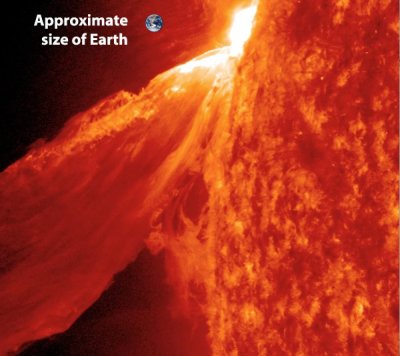
solar-flare-earth

The Carrington Event pretty much occurred when scientists first began to study the Sun. Because another storm of that size hasn’t hit us since, scientists tend to be a bit vague about when to expect another.

However there have been similar storms that didn’t hit us – we just happened to be in the wrong place. Regardless of what you call it – Coronal Mass Ejection, Massive Solar Storm, Solar Flare – a key factor is that it is directional. Like someone on the Sun wielding a giant flashlight that they randomly aim out into space every now and then. The beam is much wider than Earth…

Major solar storms have happened in recent times that, had they struck Earth, could have been catastrophic. Example:

Massive bursts of solar wind and magnetic fields, shot into space on July 23, 2012, would have been aimed directly at Earth if they had happened nine days earlier. The bursts would have wreaked havoc on the Earth’s magnetic field, matching the severity of the 1859 Carrington event. [Reuters]

And in historical times there was what looks like a far larger solar storm, with enough energy to strip our ozone layer:

What Miyake found was a startling spike in carbon-14 levels around
the year AD 775. In other words, a radiation storm – and a big one at
that.


It is at least 20 times bigger than the biggest solar
storm ever recorded, by English astronomer Richard Carrington in
1859. “We can absolutely say that what happened then was bigger than
Carrington,” says Usoskin. It is also 100 times bigger than any flare
in the last century, according to David Eichler, a physicist from
Ben-Gurion University of the Negev in Israel.

There were no matching supernova remnants, so the scientists looked to our Sun as the culprit. This possible description of aurorae from that period is a good match for collaborating evidence:

“Fiery and fearful signs were seen in the heavens after sunset; and serpents
appeared in Sussex, as if they were sprung out of the ground, to the
astonishment of all,”

The Sun may have had some help in the flare formation:

Eichler estimates that to spark a superflare, a comet the size of Hale-Bopp, which reappeared in the sky in 1997 and is estimated to be between 40 and 80 kilometres across, would be needed [to crash into the Sun]. [New Scientist]

If it was caused by a cometary collision, we will hopefully be well-warned before the next one. But if it was a random super-massive solar storm, the fore-warnings will be brief or non-existent.

We have been uniquely vulnerable (especially in modern societies) for a relatively short period. But our reliance on electronics is getting to a point where a solar storm bringing us to our knees is looking inevitable. Not a matter of if, but when.

Wall Street Titans Bunkering Down

I guess it is human nature – when you have so much money that it can help many future generations of your progeny, you do your best to make sure it gets to them.

Smarter still is to use some of that money to ensure that they survive at all.

The client, a senior partner at Goldman Sachs, wanted him to design a family house in upstate New York with a difference. It wouldn’t just be completely ‘off the grid’, with its own power and water supplies, but — and there isn’t yet an architectural term for this — it would be post-apocalypse. The conventional house would be mirrored below ground with pretty much identical living quarters that would be completely secure and so self-contained that there would be facilities to hydroponically grow plants and vegetables without soil.
[Source: The Spectator]

This isn’t a unique case, another prominent example is the Walton (Walmart) family and their compound. What pleases me is that (seemingly) such preparations are occurring in a post-2012 era.

The article mentions a 2nd Wall Street millionaire:

The strange thing was that when my friend rang a mechanical engineer for advice on a few technical details, rather than be gobsmacked, the engineer said he’d been working on pretty much the same brief for another Wall Street titan. Only he wanted a moat, too. ‘What do they know that we don’t?’ the architect asked me.

I would do the same, if I had the cash. But presumably I’d invest in weapons and secrecy over a moat.

Western USA – Not Fit For Survival

Obviously this is a generalisation – the west of the USA is close to half a continent. There will be some great survival spots here and there.

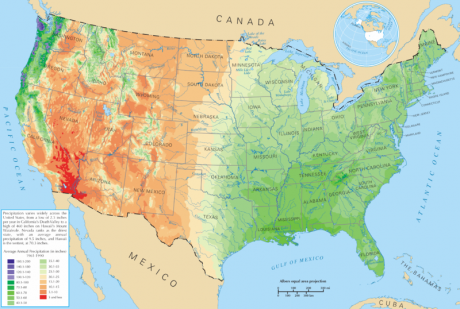
But generally speaking, the West is dry, and the East is not:

usa-rainfall


According to the rainfall map, there is a clear mid-continent dividing line. The upper West coast gets a lot of rain, but that is of no use when folk flee an earthquake or volcanic eruption.

New Mexico and Arizona have numerous towns that attract new agers and survivalist types. Unfortunately the survivalists have made critical mistakes. To survive you will need food, water, shelter and a pleasant climate. Regardless of what attracts you to a desert, you won’t be able to survive for long when society can’t provide you with the basics.

From my book:

Albuquerque, New Mexico is 8-9000 feet above sea level, which some survivalists find appealing. Being so far inland, height is not a necessity, and you’ll find that the arid climate and inability to grow crops major negatives for many SHTF scenarios, such as a loss of the power grid, or a pandemic. I recommend heading farther east.

If you were surviving in the West, your crops failing, your family starving, and you come across the above map – which direction would you head?

People of Long Now

The Long Now Foundation, established in 1996, is a private, non-profit 501(c)(3) organization based in San Francisco that seeks to become the seed of a very long-term cultural institution. It aims to provide a counterpoint to what it views as today’s “faster/cheaper” mindset and to promote “slower/better” thinking. The Long Now Foundation hopes to “creatively foster responsibility” in the framework of the next 10,000 years, and so uses 5-digit dates to address the Year 10,000 problem (e.g., by writing “02014” rather than “2014”).
http://en.wikipedia.org/wiki/Long_Now_Foundation

There are futurists who make predictions, and there are futurists who set in motion things that will be mostly useful in the future. In the latter category is an extraordinary group of people –  and I feel I would trust them more (with our future) than any other group. Easily.

Check out this list of amazing people, and what they would contribute to a library designed to kickstart a new civilisation (after a catastrophe perhaps) and sustain it:

I have long pondered over the books and information that would be most important to keep. These learned folk are providing great input.

Actually Leaving Earth to Survive!

Researchers around the UK are working with colleagues from the USA, Italy and the Netherlands on Project Persephone, investigating new biotechnologies that could one day help to create a self-sustaining spacecraft to carry people beyond our solar system.

The craft would incorporate into its structure organic matter such as algae and artificial soil, using the Sun’s energy to produce biofuel and a sustainable source of food. It would need to keep a few thousand people alive for generations on a one-way mission to find a new world to inhabit.
http://www.theaustralian.com.au/news/world/space-ark-planned-for-a-dying-planet/story-fnb64oi6-1226898083061#

The technology isn’t there yet, but these folk have set a realistic deadline of 2100. I have a lot of respect for anyone (in this age of re-election being the primary goal) that has a goal they will never personally witness. I love legacy

icarus

http://www.icarusinterstellar.org/

The plan is to leave Earth, and find a new place for humankind to flourish. It’s sad to say, but almost certainly one day we will attempt this because we have to.

THIS ISN’T A DAYDREAM

Not only is their website overflowing with great ideas, take a look at the peer-reviewed works of their alumni:
http://www.icarusinterstellar.org/publications/

Personally, I envisage I will need to have both feet on solid ground coupled with the idea of fighting to the end. I would prefer running away over fighting if I could do so on planet Earth. But if the Sun or planet Earth is the enemy, taking off through space is a smart option.

Piñata – Global Mystery

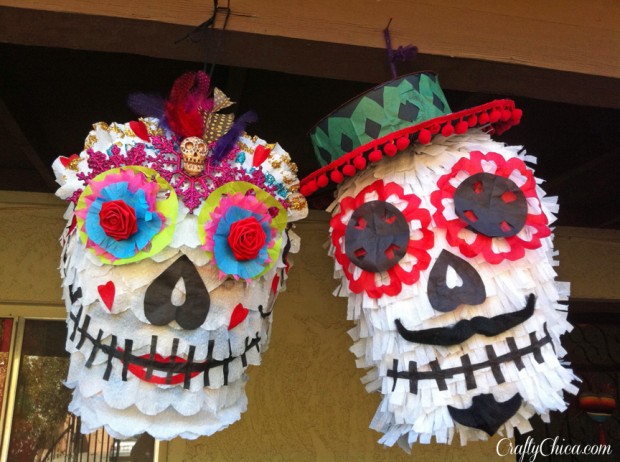
pinata
 [Source: http://www.craftychica.com/site/2012/10/i-made-more-sugar-skull-pinatas/]

I actually came across this watching a TV cooking show. I’m surprised that I have not read of this previously, and I suspect that the original sources are suspect.

Still, if you look at Wikipedia, the Piñata concept was global in ancient times:

  • Spain
  • Denmark
  • India
  • Japan
  • Philippines
  • China

It seems reasonably clear that the Piñata originated in China, and spread to Spain. The Spanish introduced the game to Central America, but apparently the Aztec and Maya already had something similar:

 The Mayan tradition was similar to the modern piñata tradition, including blindfolding the participant hitting the piñata. The Aztec tradition commemorated the birthday of Huitzilopochtli. Priests would place a clay pot decorated with colorful feathers. When broken with a stick or club, the treasures inside would fall to the feet of the idol as an offering.

The source of this is an article by Wendy Devlin from 2007:

At the beginning of the 16th century the Spanish missionaries to North America used the piñata to attract converts to their ceremonies. However indigenous peoples already had a similar tradition. To celebrate the birthday of the Aztec god of war, Huitzilopochtli, priests placed a clay pot on a pole in the temple at year’s end. Colorful feathers adorned the richly decorated pot, filled with tiny treasures.. When broken with a stick or club, the treasures fell to the feet of the god’s image as an offering. The Mayans, great lovers of sport played a game where the player’s eyes were covered while hitting a clay pot suspended by string. The missionaries ingeniously transformed these games for religious instruction. They covered the traditional pot with colored paper, giving it an extraordinary, perhaps fearful appearance.

http://www.mexconnect.com/articles/459-history-of-the-pi%C3%B1ata

The article cites no sources, and the other online Wikipedia references seem to be dead-ends.

Either this is a great piece of evidence for pre-Columbus contact, or simply a case of Meso-American people adopting a ritual and the history books getting a little bit muddled about it.

Does anyone know of serious research on this?

The Tower of Babel

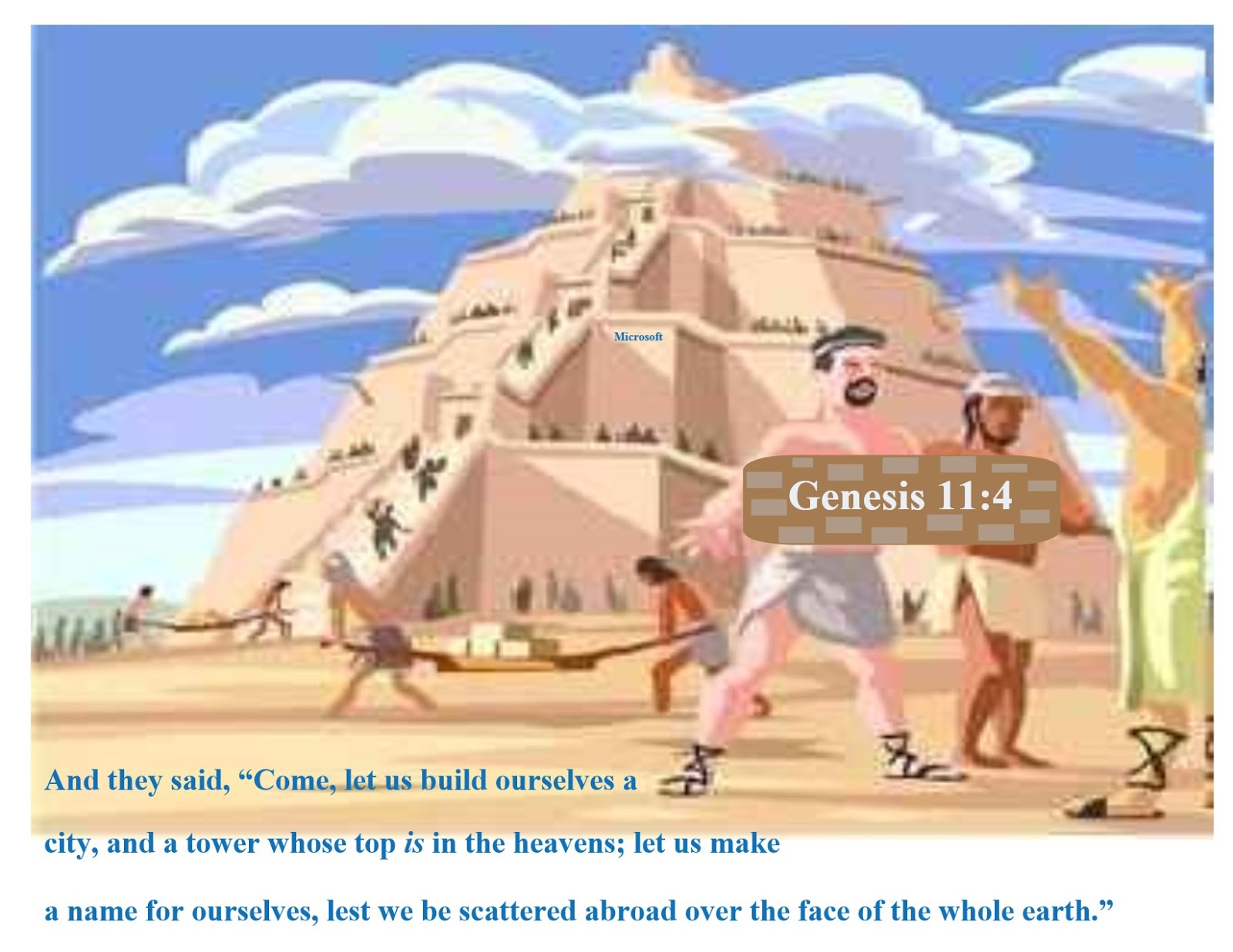
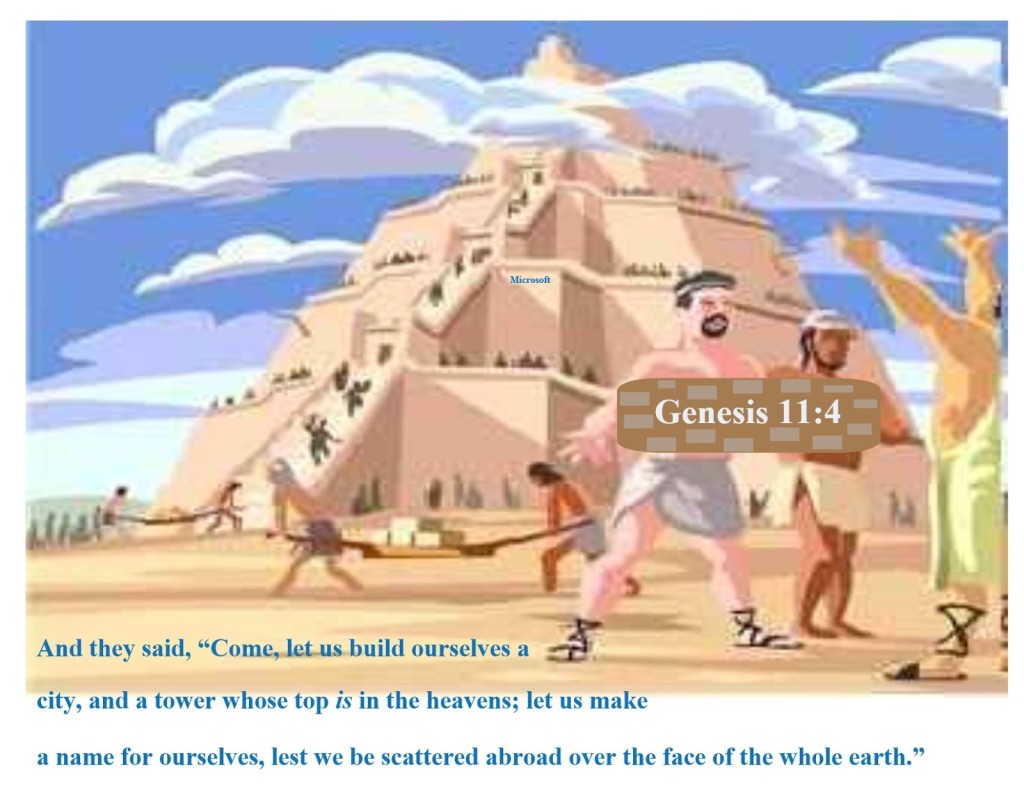
Have you ever wondered how pyramids exist all around the world, but their differences are enough to doubt a common origin? Perhaps this Biblical quote is an attempt to answer that very same question – allowing for some distortion over time?
babel-ziggurat

Now the whole earth had one language and the same words. And as people migrated from the east, they found a plain in the land of Shinar and settled there. And they said to one another, “Come, let us make bricks, and burn them thoroughly.”

And they had brick for stone, and bitumen for mortar. Then they said, “Come, let us build ourselves a city and a tower with its top in the heavens, and let us make a name for ourselves, lest we be dispersed over the face of the whole earth.”

And the LORD came down to see the city and the tower, which the children of man had built. And the LORD said, “Behold, they are one people, and they have all one language, and this is only the beginning of what they will do. And nothing that they propose to do will now be impossible for them. Come, let us go down and there confuse their language, so that they may not understand one another’s speech.”

So the LORD dispersed them from there over the face of all the earth, and they left off building the city. Therefore its name was called Babel, because there the LORD confused the language of all the earth. And from there the LORD dispersed them over the face of all the earth. Genesis 11

The one true universal language is mathematics, because it is pure. Regardless of how it might be described, it always breaks down to a pure form. And pyramids are mathematical by nature (you could argue that the form forces math to be used, but just look at the Great Pyramid and the Pyramid of the Sun – their math strongly suggests a common origin…).

So, if the Bible means mathematics when it says language, and the Tower of Babel was a pyramid, and the language of all the Earth is pyramids… The Lord confused them by making them different enough to make it hard to prove they had a common origin.

Until now I just figured global pyramids had regional differences just like modern houses do – even on the same street. Expressions of individuality within a local cultural context.

But what if the differences where deliberate? Were rebel missionaries building a legal defence, because they defied orders by convincing locals to build pyramids?

Or were the differences natural, because the missionaries / mysterious elders had to incorporate local ideas and customs when convincing locals to build such massive structures?

Regardless, it seems (to me) that the above Biblical passage is an attempt to explain the different looks of pyramids globally. And if that is the case, such questions were being asked in antiquity.

[Meanwhile I am still working on the similarities between the Tower of Babel and Noah’s Ark – there’s a small chance they were the one and the same…]

Little Red Riding Hood / Pyramids and Flood Myths

If you study ancient mysteries deeply, you always end up asking a particular question: were ancient cultures communicating with each other, or are the similarities just a combination of human nature and coincidence?

>>> pyramids everywhere
>>> flood myths everywhere

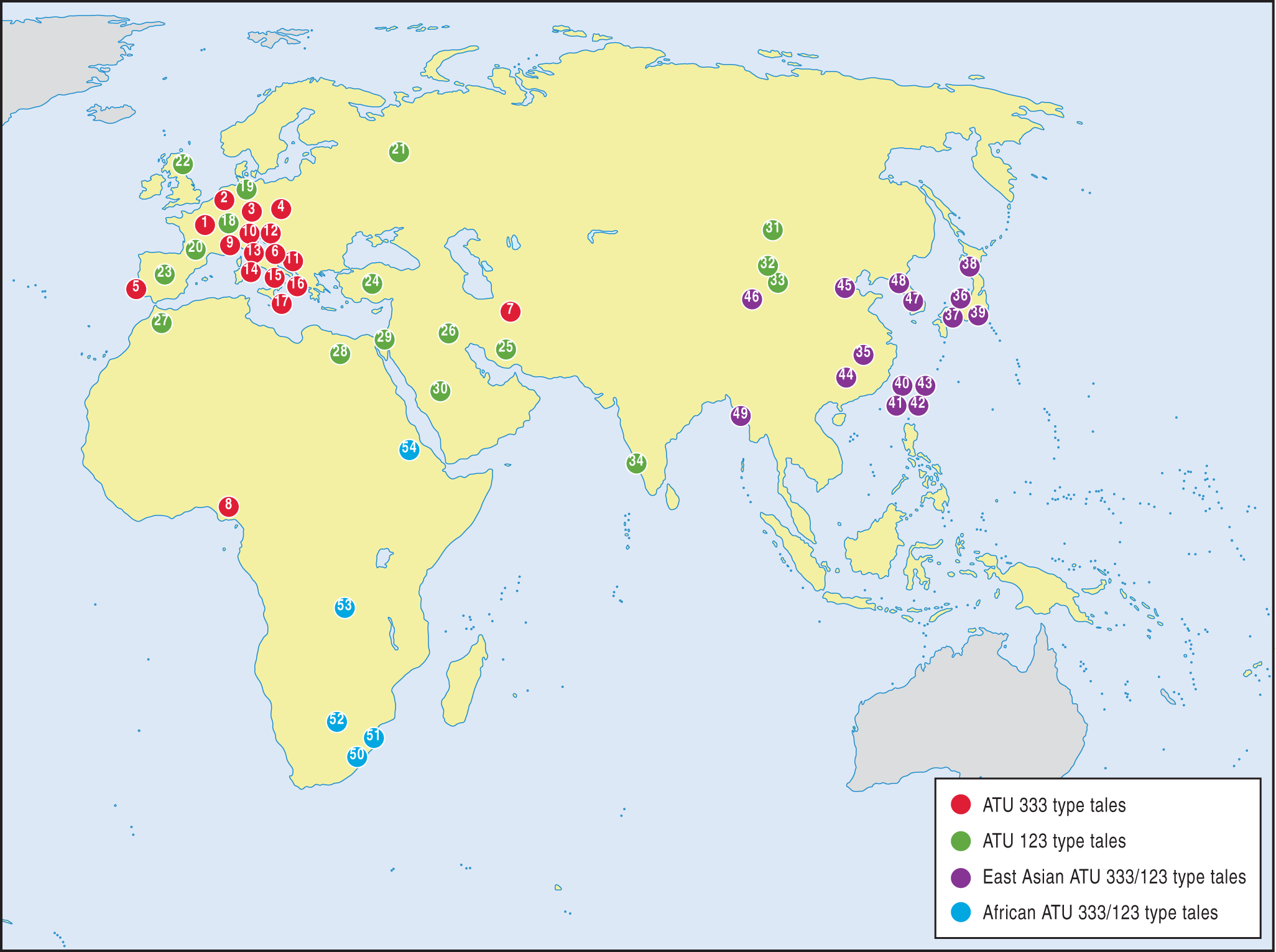
One way of tackling this question is via evolutionary biology, and in this instance the study involved the story of Little Red Riding Hood, which existed in varying forms in Europe, the Middle East, Africa and East Asia:

Those data allowed Tehrani to use phylogenetic analysis, a statistical technique used to reconstruct the evolutionary relationships between species. He started with 58 versions of the tale—all in English translation—from 33 different cultures around the world. Then, just as an evolutionary biologist compares physical traits between organisms to measure their similarity, he scored the differences between the stories using 72 plot points, such as who played the villain, what trick the villain used, and how the story ends. The output of the analysis is a family tree showing the most likely relationships.

red-riding-hood-map


red-riding-hood-tree

[images: http://www.plosone.org/article/info%3Adoi%2F10.1371%2Fjournal.pone.0078871]

the folktale seems to have emerged almost 2000 years ago somewhere between Europe and the Middle East

I can only presume that similar studies of flood myths and pyramids don’t exist – not because the research hasn’t been done – but because no discernible pattern has been discovered. One possible reason for this is the negating of global cultural communications that are outside of what orthodox science accepts.

Orange Moon / Chance of MegaQuake

The sun will be turned to darkness, and the moon to blood before the great and dreadful day of the LORD comes.
Joel 2:31 

blood-moon

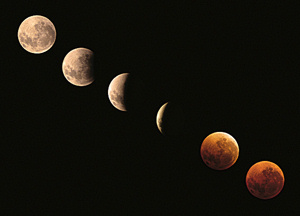
If you were following my work pre-2012 you might have seen my research connecting lunar eclipses with major earthquakes. Basically the odds of a 7.5+ quake doubles in the days surrounding a lunar eclipse.

That does not mean a big quake will certainly happen, it is still a 1-in-33 (each day) chance compared to a 1-in-74 chance on normal days.

What it does suggest to me is that a 10+ megaquake (that many experts say is impossible) would be more likely near an eclipse. In simplistic terms, there’s a tug-of-gravitational-war between the Sun, Earth and Moon, with us smack in the middle.

This particular eclipse (Tuesday morning USA time) is known as a blood moon, although SpaceWeather.com says it will be orange:

The color of Earth’s shadow, and thus the color of the eclipsed Moon, depends substantially on the amount of volcanic ash and other aerosols floating in the stratosphere. According to atmospheric sciences professor Richard Keen of the University of Colorado, the stratosphere is clear. This means the eclipse will be not “blood red,” but rather bright orange.

See for yourself. The event will be visible from Australia, New Zealand, and all of the Americas: visibility map. It’s so bright, even observers in light-polluted cities will have no trouble enjoying the show. Got clouds? No problem. The event will be broadcast live on the web by the Coca-Cola Science Center at Columbus State University in Georgia.

You may have noticed there has been quite a bit of 6.0+ earthquake activity in the last week – Chile, Nicaragua, Papua New Guinea, Solomon Islands –  so hopefully there’s nothing left in the tank.